


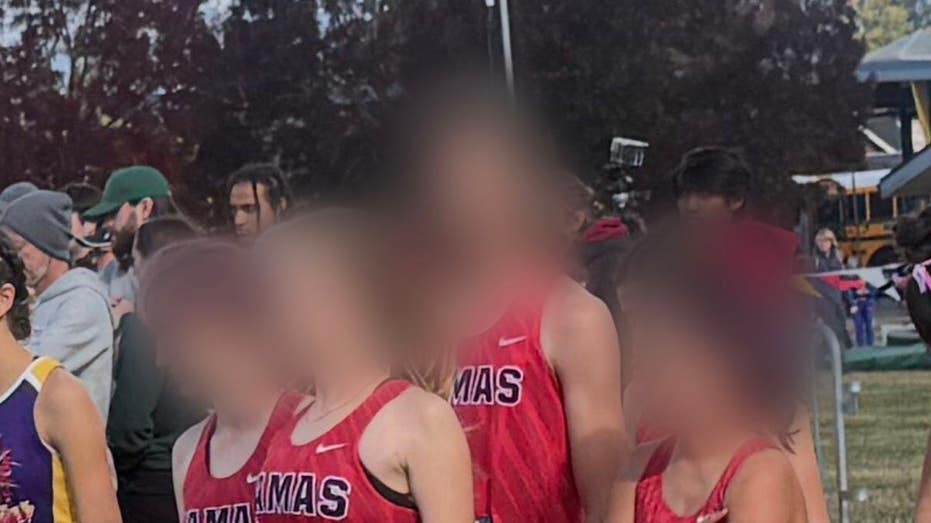
Washington state has been rocked in recent weeks by a controversy involving a male cross-country runner who switched from a boys’ team to a girls’ team mid-season. The controversy culminated in a protest Tuesday, when about a dozen female runners for Camas High School walked off the course, refusing to compete with their new male teammate.
The association governing Washington school sports says state law prevents it from implementing the proposed changes to its participation policy.
In a statement to OutKick, the Washington Interscholastic Activities Association (WIAA) said it cannot adopt a new policy to keep males out of girls’ sports, even if its members vote for a policy change, as it would be “in violation of Washington state law.”
DAD BANNED FROM SCHOOL GROUNDS AFTER PROTESTING TRANS RUNNER COMPETING AGAINST HIS DAUGHTER
“In the last two years, through the association’s amendment process, three amendments have been proposed to alter the gender-identity participation policies. Those amendments did not meet the 60% threshold to pass. Nevertheless, even if the amendments had met the threshold and passed, the WIAA cannot implement a policy that is in violation of Washington state law and the amendments proposed would have violated state law. If state law changes, the WIAA Executive Board will revise policies as necessary to remain in compliance with state law,” part of the WIAA’s statement read.
Washington voters are set to decide whether to change the rules next month.
Initiative 638, which would prohibit biological male students from competing in certain female-only school sports and require a healthcare provider’s verification of biological sex, will be on the state ballot on Nov. 3.
Democrats currently hold majorities in both chambers of the state legislature and control the governor’s office. Democratic Gov. Bob Ferguson has expressed opposition to Initiative 638.
“Washingtonians should know that I-638 won’t create opportunities for girls, but it will force them into invasive sex verification exams in order to participate in sports,” Ferguson said in a statement published Sept. 29 by the opposition campaign, No Hate in WA State.
The measure reached the ballot after lawmakers took no action on it during the 2026 session. Earlier this year, Democratic legislative leaders said they would leave the decision to voters.
The vote will come as the state grapples with multiple controversies involving males in girls’ sports, including the Camas cross-country runner and a separate incident involving a transgender wrestler who allegedly sexually assaulted a female athlete during a match last December, according to the female athlete’s lawsuit. Prosecutors declined to file criminal charges in that case.
In its statement to OutKick, the WIAA described itself as a membership-driven association whose members create its rules. It said its gender-identity participation policy has been in place since the 2007-08 school year and was adopted to align with Washington law.
“The WIAA is a membership-driven association. The membership creates the rules found in the WIAA Handbook. The gender-identity participation policies found in the WIAA Handbook at Rule 18.16.0 have been in place for 20 years, since the 2007-08 school year. The rules were passed to align with Washington state law. The WIAA remains committed to following Washington state law … which permits student-athletes to participate in sports consistent with the gender with which they identify,” the statement read.
“WIAA Handbook 18.16.0 states that school personnel will work collaboratively with the student to determine eligibility, however, a timeline for switching teams is not designated. WIAA Handbook 17.11 establishes practice regulations, outlining the minimum number of practice requirements. WIAA Handbook 18.2.1 demonstrates that student’s must be deemed eligible by the respective sport’s 50% date in order to be eligible to participate in postseason competition.
“The WIAA Handbook provides the framework for schools, leagues, and WIAA Districts to operate events throughout the year. The WIAA Office does not manage day-to-day league and WIAA District events and instead is tasked with running WIAA State Tournaments. For example, the WIAA Office establishes signage policies for WIAA State events, but not league or WIAA District contests. Once again, the WIAA is a membership-driven association.”
After the U.S. Supreme Court upheld other states’ laws restricting transgender athletes’ participation in girls’ and women’s sports in landmark rulings in June, Washington’s Office of Superintendent of Public Instruction (OSPI) said the decisions did not change Washington law. The agency said Superintendent Chris Reykdal would continue enforcing state law allowing students to compete consistent with their gender identity.
“Today’s decision reinforces Washington state’s ability to adopt and implement our own laws in alignment with our values,” Reykdal said in the June 30 statement.
The distinction matters for families seeking a different policy: a ruling allowing states to restrict participation does not itself enact such a restriction in Washington.
Initiative 638 would require school districts and covered athletic associations to prohibit students it defines as biologically male from competing with or against female students in certain competitions intended for female students only. It would apply to individual and team events.
Students entering those competitions would have to provide a signed statement from a personal healthcare provider verifying biological sex through reproductive anatomy, genetic makeup or naturally produced testosterone levels.
Backers, led by Let’s Go Washington, say the measure would preserve fair competition and opportunities for girls. They argue that transgender students would retain opportunities to participate in sports in categories corresponding to their sex.
THE CRAIG CARTON SHOW–UNFILTERED, UNAPOLOGETIC AND UNMISSABLE. DOWNLOAD HIS DAILY PODCAST NOW!
Opponents say the measure would exclude transgender girls and create new medical and privacy burdens for girls seeking to play school sports.
Supporters dispute Ferguson’s characterization of the verification requirement. Let’s Go Washington says the measure does not mandate genital examinations and that verification could occur through the existing sports-physical process.
The political decision to leave the initiative for voters was clear months before the Camas protest.
In January, Senate Majority Leader Jamie Pedersen and House Speaker Laurie Jinkins said they did not plan to hold hearings on the sports initiative and a separate parental-rights measure, according to the Washington State Standard.
“I’m certain that we will not be passing either of those initiatives,” Pedersen said, per the Washington State Standard. “They’ll be up to the voters to decide.”